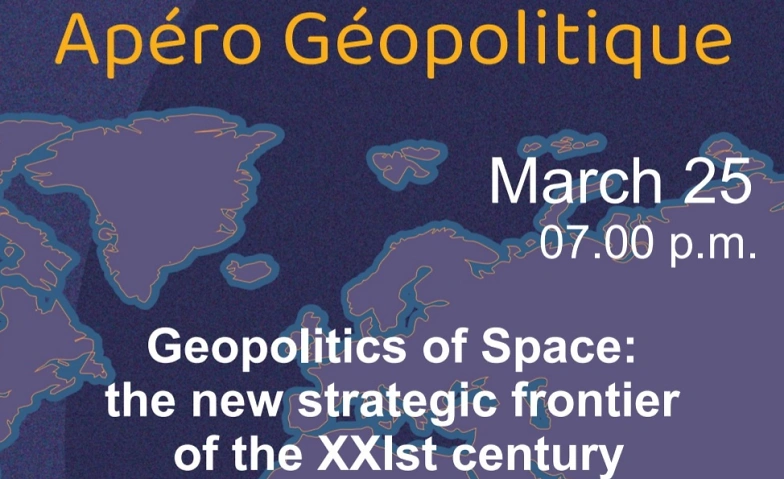
Apéro Géopolitique conference "Geopolitics of Space: the new strategic frontier of the XXIst century".
Since the launch of Sputnik in 1957 and the Apollo Moon landing in 1969, space has symbolized technological and political power. Today, however, it is entering a new phase, becoming one of the key strategic arenas of the 21st century.
Modern societies rely heavily on satellites for communication, navigation, Earth observation, and military operations. At the same time, a new space race is emerging. The United States plans to return to the Moon through the Artemis program, China is expanding its robotic and future lunar missions, India has successfully landed a probe near the Moon’s south pole, and Russia has proposed ambitious projects such as space-based nuclear power systems for future missions.
This new era is also driven by the rise of NewSpace, with major private companies, particularly in the United States, leading the development of a growing space economy based on satellite constellations, telecommunications, Earth observation, and potential space resource exploitation.
As great powers develop anti-satellite capabilities and seek to secure their orbital infrastructure, space is increasingly becoming a strategic and military domain. This raises an important question: Is
...
afficher plus
Apéro Géopolitique conference "Geopolitics of Space: the new strategic frontier of the XXIst century".
Since the launch of Sputnik in 1957 and the Apollo Moon landing in 1969, space has symbolized technological and political power. Today, however, it is entering a new phase, becoming one of the key strategic arenas of the 21st century.
Modern societies rely heavily on satellites for communication, navigation, Earth observation, and military operations. At the same time, a new space race is emerging. The United States plans to return to the Moon through the Artemis program, China is expanding its robotic and future lunar missions, India has successfully landed a probe near the Moon’s south pole, and Russia has proposed ambitious projects such as space-based nuclear power systems for future missions.
This new era is also driven by the rise of NewSpace, with major private companies, particularly in the United States, leading the development of a growing space economy based on satellite constellations, telecommunications, Earth observation, and potential space resource exploitation.
As great powers develop anti-satellite capabilities and seek to secure their orbital infrastructure, space is increasingly becoming a strategic and military domain. This raises an important question: Is space the next arena of global rivalry, or can it remain a shared frontier for humanity?
Experts:
Hicheme Lehmici, geopolitical expert, lecturer at the Swiss UMEF University of Applied Sciences Institute.
Dr. Benjamin Guyot, CEO of Spacetalk, Att. Geneva, Off. Swiss Space Command, UN Expert Group on SSA.
Dr. Urs Vögeli, Director of the Swiss Institute for Global Affairs (Bern).
afficher moins