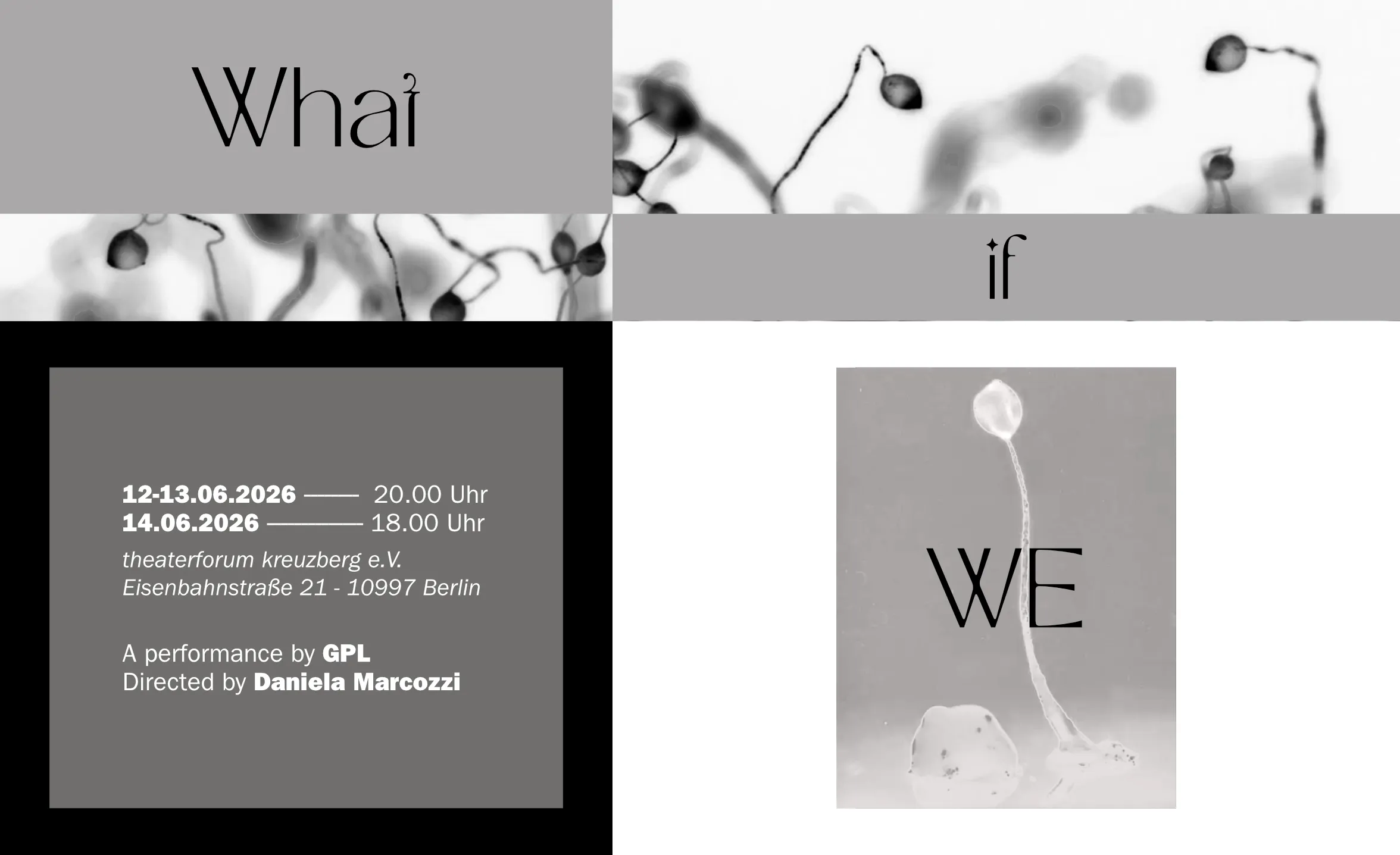
A physical theater performance inspired by the extraordinary life of Dictyostelium discoideum
Come and meet Dicty: a tiny slug-like organism you can easily find in forests during summer, only a few millimeters long, with the scientific name Dictyostelium discoideum.
But Dicty is not simply a slug. It is a living paradox: an organism that continuously assembles and disassembles itself, shifting between being one (unicellular) and being many (multicellular), depending on abundance and scarcity of resources.
When food, light, and humidity are plentiful, Dicty dissolves into thousands of autonomous amoebas. When resources become scarce, a single amoeba releases a chemical signal. Without any central command, others respond: they gather, adhere, differentiate their roles, and become a collective body-community.
Starting from this fascinating biological process, What if we opens a poetic and political reflection on human coexistence.
What makes a we possible?
What if identity is not fixed, not individual, but exists only as a transitional state?
Who sends the signal when scarcity arrives? Who responds, and at what cost?
The performance explores the tensions between cooperation and deviation, obedience and resistance, care and paralysis, powerlessness and the urgent need for action. It
...
show more
A physical theater performance inspired by the extraordinary life of Dictyostelium discoideum
Come and meet Dicty: a tiny slug-like organism you can easily find in forests during summer, only a few millimeters long, with the scientific name Dictyostelium discoideum.
But Dicty is not simply a slug. It is a living paradox: an organism that continuously assembles and disassembles itself, shifting between being one (unicellular) and being many (multicellular), depending on abundance and scarcity of resources.
When food, light, and humidity are plentiful, Dicty dissolves into thousands of autonomous amoebas. When resources become scarce, a single amoeba releases a chemical signal. Without any central command, others respond: they gather, adhere, differentiate their roles, and become a collective body-community.
Starting from this fascinating biological process, What if we opens a poetic and political reflection on human coexistence.
What makes a we possible?
What if identity is not fixed, not individual, but exists only as a transitional state?
Who sends the signal when scarcity arrives? Who responds, and at what cost?
The performance explores the tensions between cooperation and deviation, obedience and resistance, care and paralysis, powerlessness and the urgent need for action. It navigates the fragile space between saying yes and saying no, between belonging and escape, between biological impulse and political choice.
What if we is a journey through transformation as the fundamental rule of life: a dance between humidity and dryness, across a multiplicity of sexes and genders, through the unstable borders between individuality and community.
What happens when we choose to deviate from a life cycle already written? What if evolution could follow unexpected paths, toward new forms of body-communities still waiting to be imagined?
This performance invites us to rethink identity, collectivity, and the possibility of becoming together.
show less